

Balkans

Lundi 16 août 2010 1 16 /08 /2010 04:23

International Court of Justice : the unilateral declaration of independence of Kosovo was not illegal Kosovo


http://static.guim.co.uk/sys-images/Guardian/Pix/pictures/2008/02/25/kosmain.jpg


The International Court of Justice at The Hague ruled on July 22 that the unilateral declaration of independence of Kosovo was not illegal. This resolution does not imply acceptance of that decision, but does have important implications for global geopolitics.


Today only 69 of the 192 United Nations members and three of its five permanent members of the Security Council recognize Kosovo. If the former autonomous province of Serbia manages to incorporate into the UN, as required by the U.S., the floodgates will open to dozens of other provinces or ethnic groups that could seek further integration.

There is an entity, the UNPO (Organization Unrepresented Nations and Peoples), which includes 54 towns that have aspirations of becoming states. For the United Nations to incorporate a new associate mandates a series of requirements, because, otherwise, it is believed it could give the green light to a series of fragmentations and conflicts between nations.


One of the criteria it has had is that the country requesting to be part of the UN has been an entity with borders and previous administration clearly demarcated, either for having been a colony within an empire or a republic within a multinational federation.


The United Nations has taken a hundred old dependencies in Asia, Africa, the Caribbean and Oceania, but has refused to recognize the sovereignty of Biafra, Katanga, Kurdistan or the Mapuche as these areas (although they are populated by ethnic characteristics very different from their environment) never acquired a status of separate administrations during times when they were part of the last empire that dominated.


In the case of three former socialist federations of Eastern Europe, the UN has accepted the independence of the 15 republics that made up the former Soviet Union, 6 of Yugoslavia and 2 of Czechoslovakia. However, it still refuses to recognize the sovereignty of either autonomous entities before the disintegration of the federations containing each of the federated republics. (http://english.pravda.ru/hotspots/terror/114455-0/).


Cour internationale de justice: la victoire du Kosovo encourage les indépendantistes de tous bords (+ dossier)

Kosovo: The UN and the Mafia-State - M.Chossudovsky

Kosovo: La déclaration d’indépendance déstabilise l’Europe

Kosovo: Une nouvelle colonie pour Washington

   Les Damnés du Kosovo Film de Michel Collon (partie I, 31'20)

Yougoslavie, une guerre évitable (Film, 59')

Il y a un an: Le Kosovo volé (documentaire Tchèque)

Kosovo stolen (English Subtitles)

L’OTAN, un instrument de l’hégémonie américaine

Les médias pendant la guerre du Kosovo par Serge Halimi (audio vidéo)

1999 OTAN au Kosovo: "Seuls les Etats-Unis..." Par A. Sanguinetti

Serbs remaining in Kosovo (15')

Le KOSOVO et l'Ordre Westphalien par Amb James BISSETT

Les grandes puissances décident de l’avenir du Kosovo

Yougoslavia: N. Chomsky on NATO bombing (video, 36')

La mission mondiale nauséabonde de l’OTAN par Diana Johnstone

Articles sur l'OTAN/NATO Files Internationalnews

http://www.internationalnews.fr/article-international-court-of-justice-the-unilateral-declaration-of-independence-of-kosovo-was-not-illegal-dossier-kosovo-56030996.html 


Publié dans : Balkans
Ecrire un commentaire - Voir les 0 commentaires
Jeudi 22 juillet 2010 4 22 /07 /2010 00:35

Internationalnews

Le Point  22/07/2010


La victoire du Kosovo encourage les indépendantistes de tous bords

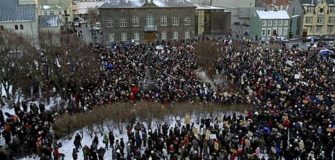
Des Kosovars célèbrent l'avis de la Cour internationale de justice qui a reconnu la légalité de l'indépendance de leur pays


De notre correspondant à Bruxelles, Alain Franco


Une onde de choc a traversé les chancelleries jeudi après-midi. Alors qu'on attendait un texte alambiqué, mi-chèvre mi-chou, les quatorze juges de la Cour internationale de justice - chargée des litiges entre États et basée à La Haye - ont clairement tranché. Et en faveur du Kosovo : à dix contre quatre, ils ont décidé que la proclamation unilatérale du 17 février 2008, donnant naissance au Kosovo indépendant, est conforme au droit international. "On attendait un avis de ce type. Mais on ne pensait pas qu'il serait aussi clair et net", a confié Naim Malaj, ambassadeur du Kosovo en Suisse - qui abrite la plus forte communauté kosovare - sur les ondes de la radio suisse romande.


Si, juridiquement, il ne s'agit que d'un avis, en rien contraignant, sur le plan politique, les choses en vont autrement. En ce qui concerne les Balkans d'abord, les juges infligent un sérieux revers à la Serbie, à l'origine de la plainte. Belgrade tente de sauver la face. De La Haye, Vuk Jeremic, le ministre serbe des Affaires étrangères, a esquivé : "Il ne s'agit que d'un avis technique, qui sera intégré dans un large débat politique sur le Kosovo à l'Assemblée générale de l'ONU en septembre prochain." La Serbie ajoute : "Nous ne reconnaîtrons jamais l'indépendance autoproclamée du Kosovo."


Le soutien américain


Mais les États-Unis n'ont pas attendu pour se réjouir de l'avis de la Cour et pour appeler toute l'Europe, c'est-à-dire les cinq États de l'Union européenne qui ne l'ont pas encore fait (Espagne, Chypre, Roumanie, Slovaquie, Grèce) à reconnaître le nouvel État. "L'Europe doit s'unir vers un avenir commun", dit Washington... Un appel du pied à la Serbie à cesser son combat pacifique contre l'indépendance de son ex-province. Quant à l'Union européenne, elle fait miroiter à la Serbie une adhésion en échange d'un assouplissement de sa position : "Le futur de la Serbie est dans l'UE, de même que celui du Kosovo. L'Union est basée sur des relations de bon voisinage. L'UE est disponible pour faciliter ce dialogue entre Pristina et Belgrade", a affirmé Catherine Ashton, la chef de la diplomatie européenne. La Russie, elle, campe sur ses positions : "L'avis de la CIJ ne change rien", dit-on au ministère des Affaires étrangères à Moscou.


Mais l'opinion des juges aura des répercussions bien au-delà des Balkans. Elle sera sans doute disséquée par les juristes. D'ores et déjà, elle n'en constitue pas moins un encouragement pour les indépendantistes dans le monde entier - Basques, Catalans, Tibétains... et la liste n'est pas close - qui revendiquent leur propre État. En ce sens, les juges de La Haye, ont rendu un avis qui fera date.


Parmi les articles précédents:

Kosovo: la déclaration d’indépendance déstabilise l’Europe

Kosovo: the UN and the mafia-state par Michel Chossudovsky

Les damnés du Kosovo film de Michel Collon (partie I, 31'20)

Kosovo: une nouvelle colonie pour Washington

Les médias pendant la guerre du kosovo par Serge Halimi (audio vidéo)1

1999 OTAN au Kosovo: "seuls les Etats-Unis…" par Antoine Sanguinetti

Le KOSOVO et l'Ordre Westphalien par Amb James BISSETT

Les grandes puissances décident de l’avenir du Kosovo

Au KOSOVO, l’OTAN a créé l’enfer au lieu de la Paix

Yougoslavia: N. Chomsky on NATO bombing (video, 36')

La mission mondiale nauséabonde de l’OTAN par Diana Johnstone

Serbs remaining in Kosovo (15')


Source: http://www.lepoint.fr


http://www.internationalnews.fr/article-cour-internationale-de-justice-la-victoire-du-kosovo-encourage-les-independantistes-de-tous-bords--54481811.html


Communauté : Actualités Internationales - Publié dans : Balkans
Ecrire un commentaire - Voir les 0 commentaires
Jeudi 24 décembre 2009 4 24 /12 /2009 20:52
http://www.whchen.com/blog/wp-content/uploads/2008/04/democracy_will_come_to_you.jpg 
German Documentary about the Lie's of Western Officials during the NATO Aggression against Serbia in 1999. How the Western constructed Lies about slaughter of Albanians by the Serbian Security Forces.


http://www.internationalnews.fr/article-10-years-ago-nato-aggression-against-serbia-1999-it-started-with-a-lie--33059533.html


Publié dans : Balkans
Ecrire un commentaire - Voir les 0 commentaires
Vendredi 4 septembre 2009 5 04 /09 /2009 20:11

Michel Collon - Pour vous fournir un instrument pratique qui vous permettra de montrer très concrètement les objectifs et les trucages de toutes les guerres de la globalisation. 1. Parce que la guerre contre la Yougoslavie a été l’exemple le plus réussi d’une guerre économique et stratégique camouflée en guerre humanitaire. 2. Parce que si on peut démontrer comment l’opinion a été manipulée par cette propagande de guerre, alors on sera mieux armé pour analyser toutes les prochaines guerres de la globalisation. 3. Parce que les bombardements et l’embargo contre la Yougoslavie ont été l’œuvre des Etats-Unis, mais aussi de l’Union Européenne. 4. Parce que, pour débloquer le débat figé par la pensée unique, il fallait d’abord donner la parole aux victimes dont personne ne parle : Serbes, Juifs, Roms, Musulmans, Turcs, Gorans… soumis depuis 5 ans au nettoyage ethnique avec la bénédiction de l’Otan. Yougoslavie, Serbie, Guerre, USA, Etats-Unis, France, Pétrole, Base, Militaire


Kouchner, vrai ou faux: interview de michel collon (2 vidéos)


Tous les articles: Balkans

Site : Michel Collon

Voir : http://www.dailymotion.com/video/x2kko3_michel-collonla-geostrategie-des-et_politics
Publié dans : Balkans
Ecrire un commentaire - Voir les 0 commentaires
Mercredi 29 avril 2009 3 29 /04 /2009 06:56
VIDEO: Humanitarian Intervention Challenged
The Centre for Research on Globalization presents Diana Johnstone, filmed in Belgrade, Serbia at the March 24, 2009 commemoration of NATO aggression against Yugoslavia. 


The following text was prepared by Diana Johnstone and presented in Montreal on 24 March 2009
as part of the "Humanitarian Intervention Challenged" Conference held at Vanier College. The Conference was organised by Vanier College and the Centre for Research on Globalization (CRG).


Dear Friends in Canada,

I hope this commemoration can be used not only to deplore the past, but also take a look at what the 1999 NATO war against Yugoslavia implies for the future.

That war opened a new phase of history.

Yugoslavia was used to release the United States from the restraints of the post-World War II system of international law. Complicated conflicts, with multiple causes, both internal and external, were presented as a simple contest between good and evil. The conflict in Kosovo between the Yugoslav state and Albanian secessionists was exploited in order to stage a little war “out of area”, beyond the defense perimeter of the Atlantic Alliance. It was a war NATO was sure to win. This initiated a new era in which the United States could proceed freely to pursue world conquest, dragging its NATO allies behind.

Of course, it is never called “world conquest”. Sometimes it is called “humanitarian intervention”, sometimes it is called “the war on terror”, sometimes it is merely “ensuring stability” or “promoting democracy” through “regime change”. But if you examine it carefully, what is going on is a project for world conquest. It probably will not succeed – such projects rarely succeed – but that is what it is. 

How and why is the United States pursuing world conquest? This is too vast a subject to explore here, but I want to suggest that this project of world conquest is very largely a matter of institutional inertia. 

In January 1961, in his farewell speech as he left the Presidency, General Dwight D. Eisenhower warned of the “military-industrial complex”.  Eisenhower did not suggest dismantling the military-industrial complex. He only called on “an alert and knowledgeable citizenry” to keep it from getting out of hand. Well, an “alert and knowledgeable citizenry” has been asleep at the switch for about half a century.

The original expression was “the military-industrial-congressional complex”, but Eisenhower decided to let congress off the hook. Nevertheless, Congress is an essential part of the whole complex, because congressmen vote regularly for military appropriations to benefit their constituencies. Congress votes for weapons systems the Pentagon hasn’t even asked for and doesn’t know what to do with. That is the pork barrel system that has kept military spending soaring and more and more weapons being researched, developed and built.

This military-industrial-congressional complex requires that the expensive weapon systems be used from time to time. Weapons need to be tested in real life situations, used up – to make way for more – and demonstrated for sale to client states. But more noble pretexts are required. Thus the Complex creates the need for enemies, for threats, for ideological justification of war. For over forty years, the “communist threat” did the trick. The Complex was briefly in a state of shock when Gorbachev spoiled everything by abruptly ending the Cold War. What to do without it?

The system needs enemies, it needs war, to keep functioning. In the early 1990s, the United States was short of enemies and threats. It turned instead to “humanitarian intervention” as a way to revive NATO and rehabilitate war as the way to solve problems.

The choice of the Serbs as enemies seems very strange – especially to the Serbs themselves. The Serbs were allies of the West in two world wars, they were pro-French, pro-American, pro-Western. But ironically, the very fact that the Serbs were so friendly to the West has made them the perfect target for a no-casualty NATO war. They never thought they were at war with the West, and never really fought back. This made them the perfect enemy for a low-risk NATO experiment.

The Serbs have been used for over fifteen years as guinea pigs.

First of all, the Serbs have been the guinea pigs in an experiment in propaganda demonization. 

They have been guinea pigs in the use of weapons using depleted uranium.

They have been guinea pigs in bringing a defenseless country to its knees by use of aerial bombing.  Since the overwhelming majority of countries in the world are defenseless against US bombing, this could happen to almost anyone.

They have been guinea pigs in a scandalous judicial experiment in The Hague, staffed and financed by NATO governments to justify NATO bombing.

They have been guinea pigs in an experiment in political subversion, spearheaded by the notorious “Otpor”, financed and trained by the US government to interfere with the electoral process in Yugoslavia so as to stage a phony “revolution” to overthrow Slobodan Milosevic. Otpor has gone on to serve its US paymasters in propagating similar phony “revolutions” to put US puppets in power in Georgia and Ukraine.

The Serbs are still guinea pigs in a disgraceful exercise of blackmail and enticement – the carrot and the stick – pursued by the European Union, which for the past decade has held out the mirage of membership in the European Union to bully Serbian leaders into more and more concessions, for which they get a few crumbs now and then, but never anything resembling recognition of Serbia’s right to justice, or even to existence.

I might add that the Albanians were also used as guinea pigs. But in laboratory experiments, some rats are starved and others are fattened. The Albanian laboratory rats were fattened. This was certainly not for their own good.

The Albanians of Kosovo were used as pawns, to achieve three aims:

1 – To further weaken and break up Yugoslavia, which had been the only independent socialist country in Europe which had close ties with the Third World, notably Arab countries, through the Non-Aligned Movement. Both Yugoslav socialism and non-alignment were weak and fading.  But the United States preferred to wipe out all traces of such independent tendencies, just in case, as well as to weaken Serbia, considered a potential ally of Russia.

2 – To provide a new “humanitarian” mission for NATO, as a pretext to change the nature of the alliance from defense of its members to “out of area” operations anywhere in the world where the United States chooses to intervene.

3 – To build Camp Bondsteel, as a part of extension of US bases eastward toward both Russia and the Middle East.

In May, 2000, conservative German Bundestag member Willy Wimmer, vice president of the Parliamentary Assembly of the OSCE, attended a high-level conference in Bratislava organized by the US State Department and the American Enterprise Institute on NATO expansion and the Balkans. In a letter to Gerhard Schröder, the German Chanceller at the time, Wimmer enumerated the conclusions of the conference, including these crucial points:

-- The war against the Federal Republic of Yugoslavia was waged in order to rectify General Eisenhower’s erroneous decision, during World War II, not to station US troops in Yugoslavia. For strategic reasons, American troops must be stationed there, to make up for the missed opportunity from 1945.   In short, the war was waged to build Camp Bondsteel.

-- The Kosovo war represented a precedent, to be followed in the future.

-- Serbia (probably for the purposes of securing an unhindered US military presence) must be permanently excluded from European development.

-- NATO must gain total control over St. Petersburg’s access to the Baltic Sea.

I repeat: “Serbia must be permanently excluded from European development.”  This can explain why the European Union keeps demanding more and more concessions before moving ahead on Serbia’s desire to join.

There is no reason to believe that NATO’s war against the Serbs is over.

I mentioned that Yugoslavia served as an experimental laboratory for interventions elsewhere. It is important to realize that the main place where the lessons from this laboratory could be applied is Russia. This was no doubt in the minds of some of the strategists who steered the US military juggernaut in the direction of Yugoslavia. For some, Yugoslavia was a miniature Soviet Union. 

One of these was apparently the influential strategic thinker Zbigniew Brzezinski, the son of a former Polish ambassador to Canada.  Brzezinski gives every sign of being a Polish patriot, still fighting with Russia over which country will dominate the lands between Poland and Russia, in particular the Ukraine, which has alternately been part of the Russian and Polish empires. Thus Brzezinski speaks repeatedly of “the Russian threat” to the Ukraine, while the United States builds military bases and holds joint military exercises with countries all around Russia and demands that Ukraine join NATO.

Now I want to call attention to a most significant parallel. Where did the wars of Yugoslav disintegration break out most violently? In a region called the Krajina.  Krajina means borderland.  So does Ukraine – it is a variant of the same Slavic root. Both Krajina and Ukraine are borderlands between Catholic Christians in the West and Orthodox Christians in the East. The population is divided between those in the East who want to remain tied to Russia, and those in the West who are drawn toward Catholic lands.  But in Ukraine as a whole, polls show that some seventy percent of the population is against joining NATO. Yet the US and its satellites keep speaking of Ukraine’s “right” to join NATO. The right not to join NATO is not mentioned.

The condition for Ukraine to join NATO is expelling foreign military bases from Ukrainian territory. That means expelling Russia from its historic naval base at Sebastopol, essential for Russia’s Black Sea fleet. Sebastopol is on the Crimean peninsula, which was transferred from Russian to Ukrainian administration only in 1954, although the population is more than two thirds Russian and never intended to leave Russia.

As the same causes may have the same effects, the US insistence on “liberating” Ukraine from Russian influence may have the same effect as the West’s insistence on “liberating” the Catholic Croats from the Orthodox Serbs. That effect is war.  But instead of a small war, against the Serbs, who had neither the means nor the will to fight the West, meaning a war NATO could win with one hand tied behind its back, a war in Ukraine might lead to a NATO war with Russia. A nuclear superpower.

Recently, with the election of Barack Obama, the style of the US government has changed. Where the George W. Bush administration acted unilaterally, the Obama administration wants to act multilaterally. With allies. But the war in Afghanistan goes on, the support to Israel is a sacred dogma, the encirclement of Russia continues.

Presidents come and Presidents go, every four to eight years. There are some differences in domestic policy. But the military-industrial-congressional complex follows its own momentum.  Until, perhaps, all the money runs out.

Meanwhile, NATO countries are being enrolled in a new crusade, in the name of vague “Western values”, to Americanize the planet. At a time when the American economic system is crashing down, when old and new civilizations are asserting themselves after several centuries of Western domination, for Europeans and Canadians to follow this doomed crusade is to follow a path of self-destruction.

Exposing the truth about the NATO agression against Yugoslavia is one small but important contribution to awakening the people of Canada and Europe to the deceitful nature of NATO’s “civilizing mission” in the world. I wish you success in this endeavor.


 Global Research Articles by Diana Johnstone

http://www.globalresearch.ca/index.php?context=va&aid=13402
Publié dans : Balkans
Ecrire un commentaire - Voir les 0 commentaires
Vendredi 24 avril 2009 5 24 /04 /2009 21:03
Publié dans : Balkans
Ecrire un commentaire - Voir les 0 commentaires
Mardi 3 mars 2009 2 03 /03 /2009 16:50
"Documentaire tchèque sur le Kosovo avec historique, magouilles des USA pour installer leur base Bondsteel, la mafia albanaise et l'héroïne, l'UCK, les violences et nettoyages ethniques, Pogrom contre les Serbes et les non-Albanais (Roms, Goranis, Turcs, Ashkalis, Juifs) - Serbie, le bombardement de la Yougoslavie, l'indépendance illégale de la province."

Communauté : Actualités Internationales - Publié dans : Balkans
Ecrire un commentaire - Voir les 0 commentaires
Mercredi 7 mai 2008 3 07 /05 /2008 00:28

Extrait du documentaire Yugoslavia : The Avoidable War
George Bogdanich et Martin Lettmayer, USA, 2000, 165', VO ST ang.

La guerre évitable est une implacable dénonciation du rôle joué par les grandes puissances dans la ruine de la Yougoslavie. Le film rappelle le déroulement d'une décennie de guerres yougoslaves, depuis les sécessions Slovène et croate jusqu'à la prise du Kosovo par les armées de l'OTAN, montre les divisions et les maladresses des alliés occidentaux et comment les États-Unis et l'Allemagne ont activement encouragé l'éclatement du pays.

On apprend aussi dans ce documentaire qu'un très grand nombre d'églises furent détruites sous les yeux de l'Otan!

Yougoslavie, une guerre évitable
envoyé par Ninotchka

Voir tous les articles sur les Balkans:
http://internationalnews.over-blog.com/categorie-10334128.html
Publié dans : Balkans
Ecrire un commentaire - Voir les 0 commentaires
Dimanche 2 mars 2008 7 02 /03 /2008 15:00
 
Global Research
March 1, 2008
 
swisstxt20070812_8099484_1.jpg
The United Nations
Contributed to
the Establishment
of a Mafia-State in Kosovo

by Michel Chossudovsky


Photo:
info.rsr.ch


International Tribunal for U.S./NATO War Crimes in Yugoslavia - 2000-06-10

The EU, the US, NATO and the UN Mission in Kosovo bear responsibility in the criminalization of Kosovo State institutions.

The following article, written in March 2000, focusses on the formation of a Kosovar Mafia State integrated by former members of the KLA. 


With the February 2008 declaration of Independence, this process has reached its completion. Kosovo is not a mafia state in its own right, it is a US/EU protectorate under NATO military rule. The government of Kosovo, which has extensive links to organized crime, serves the interests of the US-NATO occupation.


Michel Chossudovsky, 1 March 2008

-------------------------------------------------------------------------------------------------
June 10, 2000 International Tribunal for U.S./NATO War Crimes in Yugoslavia

THE UNITED NATIONS APPOINTS AN ALLEGED WAR CRIMINAL IN KOSOVO


By Professor Michel Chossudovsky

Professor Michel Chossudovsky (Canada), an expert historian and economist who has taken part in many international forums on the Balkans, showed the criminal role of the so-called Kosovo Liberation Army and its ties to U.S. and German intelligence services, ties to NATO and the United Nations Rep. Bernard Kouchner. Michel Chossudovsky, professor of economics, University of Ottawa, author of a forthcoming book entitled "War, Globalization and the New World Order"

The United Nations in a recent [2000] report submitted to Secretary General Kofi Annan now concedes that the Kosovo Protection Force (KPC) (inaugurated under UN auspices in September 1999) has been involved in "criminal activities-killings, ill-treatment/torture, illegal policing, abuse of authority, intimidation, breaches of political neutrality and hate speech"1.


And in a cruel irony, "the United Nations is paying the salaries of many of the gangsters."2 The Kosovo Liberation Army (KLA) --known for its connections to organized crime and the Balkans narcotics traffic was officially dissolved and transformed into the Kosovo Protection Corps (KPC) modelled on the US National Guard. Funded by US military aid, the KPC is trained by Military Professional Resources Inc (MPRI), a mercenary outfit based in Alexandria, Virginia.


The KPC was slated by the United Nations to become --in the words of UNMIK Special Representative Bernard Kouchner [now France's Minister of Foreign Affairs] "a civilian, disciplined, uniformed and multi-ethnic emergency response... with a mandate to "providing humanitarian assistance... and contributing to rebuilding infrastructure and communities...."3


Shift in military labels. KLA Commander Agim Ceku was appointed Chief of Staff of Kosovo’s newly created Armed Forces. In the words of Bernard Kouchner during the inauguration ceremony: I look to him [Agim Ceku] to lead the new members of the Corps in the footsteps of Cincinnatus, the model citizen-soldier of ancient Rome -- who left his plow standing in the field to answer the call to arms & and at the end of the war refused all honors in order to return to his civic duties.4


Barely a few weeks later, the International Criminal Tribunal for the former Yugoslavia (ICTY) announced it was "investigating Ceku for alleged war crimes committed against ethnic Serbs in Croatia between 1993 and 1995." 5 The information, however, was known to military and intelligence analysts well in advance of Ceku’s appointment. It had been withheld from public opinion by the ICTY during the mandate of Chief Prosecutor Louise Arbour. Jane Defence Weekly (10 May 1999) had confirmed that Ceku had "masterminded the successful HV [Croatian] offensive at Medak [in 1993] and in 1995 was one of the key planners of the successful Operation 'Storm ". United Nations Special Representative Dr. Bernard Kouchner (who is a 1999 Nobel Peace Laureate for his role as co-founder of Doctors without Borders) must have known.


The UN and NATO had access to the files of the ICTY. The Tribunal’s Chief Prosecutor knew and had the responsibility under the statutes of the ICTY of reporting the matter to the UN Secretary General. In a cruel irony, the United Nations had casually proceeded with the appointment of an individual who according to the files of a United Nations body (namely the ICTY) was an alleged war criminal. Surely some questions should have been asked.


When the information was released barely a few weeks after Ceku’s appointment: "a diplomat close to Bernard Kouchner the UN special representative [declared] "If we lose him {Agim Ceku] it will be a disaster," ... "When you get to the second level of the TMK [Kosovo Protection Corps], you're down to a bunch of local thugs."... 6 "American diplomats... have suggested any indictment of Ceku would most likely be "sealed" and thereby kept out of the public domain... "[T]he NATO-led peacekeeping force, could not contemplate a public relations disaster with the Albanians by arresting Ceku".7 According to the Sunday Times (London), "[t]he possibility that Ceku, a respected figure in Kosovo, could be accused of war crimes, [had] sent shivers through the international community... "8.


Meanwhile, the ICTY had reassured public opinion that the "[T]he court's inquiries ... relate[d] to atrocities committed in Krajina, ... between 1993 and 1995"... Ceku's record in Kosovo itself is not thought to be in question, although the office of Carla del Ponte, the new chief prosecutor, said an investigation into his activities with the KLA could not be ruled out..."9


War Criminals call the Shots


Visibly what was shaping up in the wake of the bombings in Kosovo was the continuity of NATO’s operation in the Balkans as well as its reliance on war criminals in its "peace-keeping" undertakings. Military personnel and UN bureaucrats previously stationed in Croatia and Bosnia had been routinely reassigned to Kosovo.

Lieutenant General Mike Jackson was posted to Kosovo as KFOR Commander following his earlier stint in Bosnia Herzegovina and Croatia. In the immediate wake of the 1995 ethnic massacres in Krajina (for which Agim Ceku is under investigation by the ICTY), General Michael Jackson was put in charge as IFOR commander, for organising the return of Serbs "to lands taken by Croatian HVO forces in the 1995 Krajina offensive".10


And in this capacity Jackson had "urged that the resettlement [of Krajina Serbs] not [be] rushed to avoid tension [with the Croatians]" while also warning returning Serbs "of the extent of the [land] mine threat."11. In retrospect, recalling the events of early 1996, very few Krajina Serbs were allowed to return to their homes under the protection of the United Nations. According to "Veritas" (a Belgrade based organization of Serbian refugees from Croatia), some 10,000-15,000 Serbs were able to resettle in Croatia. Jackson’s experience in "ethnic warfare," however predates the Balkans. From his earlier posting In Northern Ireland as a young captain, Jackson was second in command in the "Bloody Sunday" massacre of civilians in Derry in 1972.


Under the orders of Lieutenant Coronel Derek Wilford, Captain Jackson and thirteen other soldiers of the parachute regiment opened fire "on a peaceful protest by the Northern Ireland civil rights association opposing discrimination against Catholics. In just 30 minutes, 13 people were shot dead and a further 13 injured. Those who died were killed by a single bullet to the head or body, indicating that they had been deliberately targeted. No weapons were found on any of the deceased."12 Jackson's role in "Bloody Sunday" "did not hinder his Military career." 13 From his early stint in Northern Ireland, he had been reassigned under United Nations auspices to the theatre of ethnic warfare first to Bosnia and Croatia and then to Kosovo...


In Kosovo, the conduct of senior military officers conforms to the Croatian and Bosnian patterns, the same key individuals were reassigned to "peace-keeping" roles in Kosovo. While General Jackson displayed token efforts to protect Serb and Roma civilians, those who fled Kosovo during his mandate were not encouraged to return under UN protection... In post-war Kosovo, the massacres of civilians was carried out by the KLA (and subsequently by the KPC) under the auspices of NATO and the UN. It was accepted by the "international community" as a "fait accompli".


The Installation of a Mafia State


While calling for the installation of democracy based on "transparency" and "good governance", the US and its allies have installed in Kosovo a self proclaimed civilian paramilitary government with links to organised crime. The outcome is the outright "criminalisation" of State institutions in Kosovo and the establishment of what is best described as a "Mafia State". The complicity of NATO and the Alliance governments (namely their relentless support to the KLA provisional government) points to the de facto "criminalisation" of KFOR and of the UN peace-keeping apparatus in Kosovo.


The donor agencies, the United Nations and Western governments in providing financial support to the KPC are, in this regard, also "accessories" to this criminalisation of State institutions. Through the intermediation of a paramilitary group (created and financed by Washington and Bonn), NATO and the UN bear the burden of responsibility for the massacres of civilians and the prevailing reign of terror in Kosovo.


NOTES


1. Quoted in John Sweeney and Jen Holsoe, Kosovo Disaster Response Service Stands Accused of Murder and Torture, the Observer, 12 March 2000.
2. Ibid.
3. Statement by Bernard Kouchner, 21 September 1999 on the occasion of the inauguration of the KPC, see http://www.un.org/peace/kosovo/pages/kosovo5.htm
)
4. Ibid
5, AFP, 13 October 1999
6. Tom Walker, "Kosovo Defence Chief Accused of War Crimes, Sunday Times, 10 October 1999.
7. Ibid
8. Ibid
9. Ibid
10. Jane Defense Weekly, Vol 23, No. 7, 14 February 1996.
11. Ibid
12. Julie Hyland, "Head of NATO Force in Kosovo was Second-in-command at "Bloody Sunday" Massacre in Ireland", World Socialist Website, 19 June 1999.
13. Ibid.

Other articles by Michel Chossudovsky on Internationalnews:


www.globalresearch.ca/index.php?context=va&aid=8183


Communauté : Actualités Internationales - Publié dans : Balkans
Ecrire un commentaire - Voir les 0 commentaires
Samedi 1 mars 2008 6 01 /03 /2008 11:15

Mondialisation.ca
Le 25 fevrier 2008

uck.jpg

Il paraissait impossible de réduire encore plus l’ex-Yougoslavie déjà réduite à la portion congrue, mais non: avec la reconnaissance immédiate des USA et de la majorité de l'Union Européenne, la soi-disant indépendance du Kosovo est chose faite. Peu importe que cet acte viole le droit international, la Charte des Nations Unies et les résolutions de son Conseil de Sécurité. Le fait décisif est qu’ainsi l’ont voulu les « faucons-poulets » de Washington avec le soutien d'une portion bien armée de l'OTAN et une ONU qui regardait ailleurs. Les conséquences sont inimaginables et on se souvient de la prophétique phrase d'Otto von Bismacrk à la fin du XIXe siècle : « Si la Grande Guerre éclatera, ce sera par la faute d’une quelconque maudite chose dans les Balkans ». Il en fut ainsi.


Terroriste de l'UCK- Photo:
resistir.info


L'Espagne et d'autres pays européens ont repoussé l'autoproclamation. Ainsi que la Russie, la Chine, l'Indonésie et d'autres pays avec des mouvements séparatistes que l'exemple pourrait encourager. Même la Turquie s'est plainte: si la sécession du Kosovo est bienvenue, pourquoi n'appuie-t-on pas la zone turque de l'île de Chypre? Mais la Russie craint en outre qu'elle ait une portée plus vaste: le faible Kosovo indépendant se soumettrait complètement à la politique des USA qui auraient l'intention d'établir là un autre segment du bouclier anti-missiles afin de renforcer ceux de Pologne et de République Tchèque. Le Kremlin est convaincu qu'il s'agit là d'un cercle dangereux pour la sécurité de la Russie. Ne le sera t-il pas également, à tout moment, pour la sécurité de l'Europe occidentale? Le centre européen permet de surveiller aussi bien à droite qu’à gauche.


Les USA ont commencé le travail kosovar il y a des années déjà. Belgrade a combattu contre le bras armé des séparatistes serbo-albanais, l'Armée de Libération du Kosovo (UCK), une créature de la CIA, comme Oussama Ben Laden. Cela a été reconnu par l'agence d'espionnage elle-même, qui lui a fournit entraînement, armes et argent, en particulier en 1998 et 1999, peu avant que les USA et l'OTAN bombardent l'ex-Yougoslavie durant 11 semaines. Le Département d'État qualifia officiellement l'UCK de « mouvement insurgé », bien que ses hauts fonctionnaires disaient hors micro qu'il s'agissait de terroristes. Bien sûr Milosevic n'était pas un saint, mais la minorité serbe du Kosovo n'oubliera pas le 17 mars 2004: l'UCK attaqua, tua une vingtaine de civils, brûla toutes les églises orthodoxes et laissa à la rue 60.000 serbo-kosovars. Tout cela dans l'indifférence des forces de paix de l'ONU stationnées dans la capitale Pristina et dans la province.

  a328_clark_ceku_2050081722-5981.jpg

Bernard Kouchner avec le leader de l'UCK Hashim Thaci et le général Wesley Clark
Photo: www.cooperativeresearch.org


W.Bush a félicité chaleureusement le Premier ministre de la nouvelle République kosovar, Hashim Thaci, leader de l'UCK converti en Parti Démocratique du Kosovo (PDK), bien que ses références ne soient pas particulièrement recommandables. « Le PDK, dirigé par Hashim Thaci, a pris le contrôle de beaucoup de municipalités à la suite de la guerre. Le parti a des liens étroits avec le crime organisé dans la province » (The Observer, 29-10-00). « L'UCK est liée à tous les cartels de la drogue connus du Moyen et Extrême-Orient. Interpol, Europol et la plupart des organismes de sécurité et de lutte contre le narco-trafic en Europe possèdent des dossiers des syndicats de la drogue qui conduisent directement à l'UCK », a souligné Michael Levine, un ancien fonctionnaire de la DEA. On estime en outre que Hashim Thaci contrôle de 10 à 15% des diverses activité délictueuses du Kosovo: contrebande d'armes et de cigarettes, vol de voitures, prostitution et autres broutilles.


De nombreux journaux du monde ont reproduit ces derniers jours une photo célèbre prise en 1999: on y voit le chef terroriste Hashim Thaci, l'observateur de l'ONU au Kosovo et aujourd'hui ministre des Relations Extérieures de France, Bernard Kouchner, Mike Jackson, alors commandant des troupes d'occupation de l' OTAN au Kosovo, Agim Ceku, chef militaire albano-kosovar accusé de crimes de guerre par les militaires canadiens, et le général Wesley Clark, à l'époque commandant suprême de l'OTAN, unissant leurs mains pour jurer qu'ils obtiendraient l'indépendance du Kosovo. Les activités d'Hashim Thaci étaient déjà bien connues.


Le très français Observatoire Géopolitique des Drogues a informé que l'UCK a aidé à introduire en Europe occidentale de l'héroïne et de la cocaïne pour une valeur annuelle de 2000 millions de dollars. Les agents allemands qui combattent les narco-trafiquants ont affirmé que ceux du Kosovo « lavent annuellement 1500 millions de dollars par l'intermédiaire de 200 banques privées et bureaux de change » (The Washington Times, 4-5-99). Ce sont les alliés de W. Bush dans la prétendue mission d'étendre la démocratie et la liberté dans le monde. Au passage, ce dernier a annoncé qu'il mettra son veto à tout projet de loi qui interdirait aux forces de sécurité usaméricaines d'appliquer la torture. Pourquoi pas.


Article original en espagnol, Página/12, publié le 24 février 2008.


Traduit par Gérard Jugant et Fausto Giudice.  Gérard Jugant et Fausto Giudice sont membres de Tlaxcala (http://www.tlaxcala.es/), le réseau de traducteurs pour la diversité linguistique. Cette traduction est libre de reproduction, à condition d'en respecter l’intégrité et d’en mentionner l’auteur, le traducteur, le réviseur et la source.


Juan Gelman est journaliste. Il publie régulièrement de nombreux articles dans Página/12, le quotidien de Buenos Aires et publiés sous le titre Prosa de prensa et Nueva prosa de prensa.

 Articles de Juan Gelman publiés par Mondialisation.ca

www.mondialisation.ca/index.php?context=va&aid=8199


Communauté : Actualités Internationales - Publié dans : Balkans
Ecrire un commentaire - Voir les 0 commentaires

Présentation/About this Site

  • internationalnews
  • : Géostratégie Ecologie/Environnement Nouvel Ordre Mondial/New World Order Santé/Health Documentaires/Documentaries Actualité
  • : Un site d'information et de réflexion sur l'actualité internationale, le nouvel ordre mondial, la géostratégie, la propagande, l'impérialisme, l'économie, l'environnement et la culture, illustré de documentaires. News and Analysis on International Issues, the New World Order, Geostrategy, Propaganda, Imperialism, Economics, Environment and Culture - Documentaries
  • Contact
  • Retour à la page d'accueil

RSS

  • Flux RSS des articles

RECHERCHER/SEARCH

LIENS/LINKS

 
Contact - C.G.U. - Signaler un abus - Articles les plus commentés